1 March 2024

Devolution and the Radical How

Stockport Town Hall


Hearing Tom Loosemore tell the story of Universal Credit made a big impact on me. It was 2016 and he came to Stockport and spoke at a conference we’d put on for local government digital folk who were trying to work in agile and collaborative ways.


I’d been an IT director for about 18 months at this point and was excitedly learning what agile delivery actually meant in practice, but Tom’s talk was the first time I understood that this learning also had meaning in the policy making half of my brain.


You can still hear Tom tell the conference about how, as part of a review team in 2013:


“We asked to see Universal Credit; ‘can you show us the thing?’ Three years in, spent £400m. They showed us…a 600 page policy manual. That’s not Universal Credit. That’s 600 pages of completely untested assumptions about the behaviours of people in very complex and difficult circumstances in their lives.”

Drive Change

Working with the Radical How


This case study surfaces again in the recent Radical How report from Public Digital and Nesta, which describes “a new approach…to shift government from an organisation of programmes, projects and paperwork, to one of missions, services and people.”


I’ve been working with a very similar framing for several years now — trying, learning, failing, trying again.


Some of this work has been in areas, like the development of a community grants service, that lend themselves to a #policydesign or Radical How approach (community grants require similar capabilities to the Universal Credit and Future of Farming case studies in the report).


A lot of my attempts to design in and deliver agility have also been in contested political spaces, like major infrastructure planning or cross-government spending reviews, where internal tension and carefully stage managed policy releases, rather than collaboration and iteration, are the default. I’m slowly distilling the practice insights from this work, for another day.


For now, among all the good stuff in the Radical How principles, the issues of accountability and devolution jumped out to me, and to others.


An analogue concept and systems of accountability are, I think, very much the root of the waterfall mindset that demands false certainty. Shifting this bit of deep state system design is probably the single biggest intervention point to increase agility (‘system acupuncture’, to borrow a phrase).


But devolution is the issue we’re working actively with at Question Factory currently so let’s stick to that.


Missions, devolution and agility


To start, we can blend national missions with place-based missions; I don’t think the approach is inherently centralist. Clear national strategy focused on outcomes, together with devolved delivery, to me seems to fit the model. A national test and trace mission could have been delivered through devolved structures without needing to adopt a waterfall approach.


In fact, I think there are at least two good reasons that greater devolution enables more agile and iterative delivery. A couple of caveats first though:


· My thinking and language are very much a product of the Greater Manchester Combined Authority because that’s the one I know the best and where we’re working these ideas through at the moment. I know other combined authorities are different but given the peer recognition of GMCA as ‘the undisputed pioneers of English devolution’, I figure learning from this system is likely to have wider relevance over time.


· By ‘greater’ devolution I mean to more places, across more areas of policy, and of more substantive powers and accountabilities. Basically, substantially re-constituting the place-based strategic capability of UK governance. We’re much more interested in capability (including culture) than in structure (with an interest in governance sitting somewhere between the two).


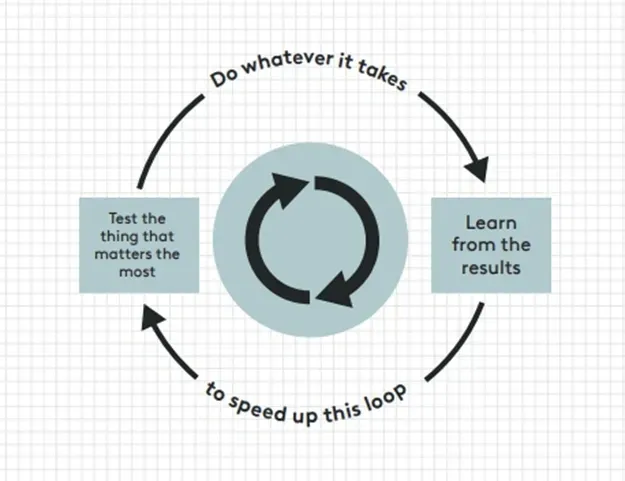
In simple terms, the value of devolution in delivering the Radical How all comes down to feedback — how do we hear it, how do we interpret it and how do we act on it? As the authors put it, do whatever it takes to speed up the test and learn loop.
Testing Cycle Graphic

Two good reasons


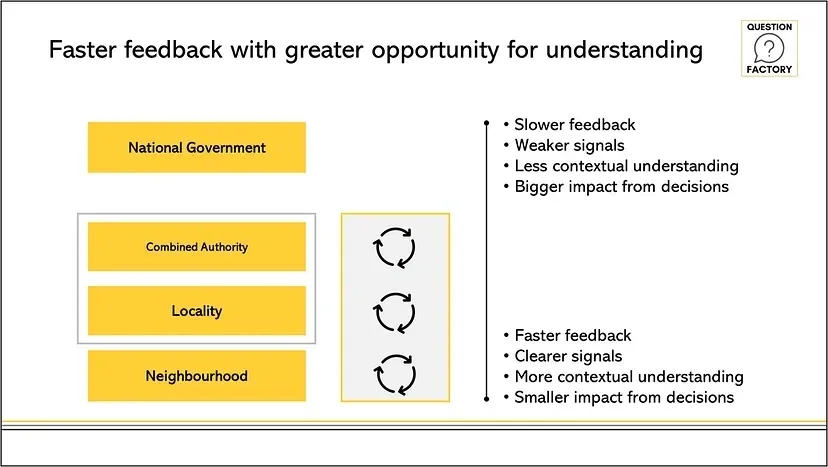
The first is a variation on a simple idea I wrote about here: that CAs have some of the strategic heft and capability of national government, but can tailor their actions more effectively to the people and places they represent. This is particularly the case where CAs see themselves as a collaborative of the local authorities (and business and civic actors), not separate from them.


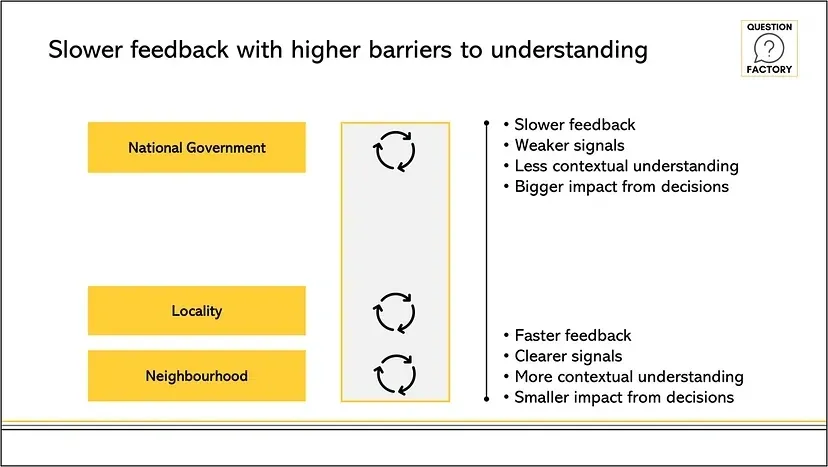
The further decisions are taken from the neighbourhood in which assumptions are tested, the slower the feedback, the weaker the signals, and the less contextual understanding there is of those signals. Socio-economic distance is as much (maybe more?) of a barrier here as miles in car or (if you’re brave) on a train.


At the same time, because our national government holds so much policy making power, the impact of decisions made on these weaker feedback signals is likely to be much greater. This increases risk as a barrier to experimentation (although it’s interesting to recognise here that devolution policy has itself been experimental).

Slower Feedback Cycle Graphic

Of course, it’s possible to shorten this loop, which is what the Universal Credit pilots did by testing and learning with 100 people in Sutton, and moving from there. But if believe in investing in systemic capability (‘fund teams not programmes’), and if we believe we need to do whatever it takes to speed up the test and learn loop, then why not try to build a more agile state by bringing power and fundings closer to everyone everywhere?

Faster Feedback Cycle Graphic

The second reason is that, when it comes to designing the capabilities we need to deliver the Radical How, Combined Authorities are the greenest of greenfields.


Many CAs aren’t constituted yet; some aren’t even conceived. All CAs, from the establishment of the GMCA in 2014, are born into the internet era. They may have been nurtured as cuttings from the rootstock of analogue local government, but in the coming years they have the chance to develop into their own radically different genus. It’s exciting.


So the second good reason we’ve observed in our work is the chance to grow and evolve Combined Authorities as vehicles for hearing, interpreting and acting on feedback, and to develop within their systems a radically integrated and impact informed approach to policy design.


This could mean linking traffic management policy to real time air quality data; working with charities and empowered frontline professionals to flex and deploy early help resources; or using deliberative dialogues to frame and iterate bigger strategic policies, or prioritise spending decisions.


To reference a local landmark, this is the idea of a Combined Authority as Jodrell Bank; built to listen.

Jodrell Bank

How do we do this? Well that’s a question we’re working through. At this stage we think it’s probably a mixture of at least these few things –


· Investing in the practice of CAs as system collaboratives, building networks and relationships that aren’t solely instrumental and distributing capability rather than hoarding it the centre


· Developing what Pia Andrews calls shared end-to-end policy infrastructure — the tools and practices that help give form to the Radical How


· And — as more power is devolved — ensuring CAs can develop ways of working that, yes, have the hard governance teeth to stop Teesworks style mis-management of public funds, but don’t lock in a mini-Whitehall mentality that fetishizes hierarchy as a source of false certainty and recreates silo barriers to mission driven government.


There is a unique and new contribution that Combined Authorities can make to implementing the Radical How, by building capabilities to seek out and respond to impact and complexity, quickly, in context and as an accountable system collaboration.


Looking at the hedged bets, radical incrementalism and requirement for unspecified ‘appropriate level(s) or capability’ in today’s Level 4 technical notethe chance to mature into this role may still need fighting for.

Thinking Out Loud

We think you
might also like

View all

Contact

Want to know more?
Drop us an email today!

info@questionfactory.co.uk