17 October 2024

Writing the future of
combined authorities

Combined Authorities were created by local authorities for local authorities.


Andy Burnham, famously, was ‘only here to do the buses’. Now all transport authorities will receive bus franchising powers, but no one thinks the work of Metro Mayors is done, least of all our new government.


The current consensus on the value of mayoral devolution heralds the second age of Combined Authorities.


The difference with this, the second chapter of the story (which is essentially a coming of age tale about an imperfect but promising governance innovation), is that it will increasingly be written not by the local authorities of which CAs are formed, but by central government officials and ministers.

Adobe Stock

In the first chapter of the story, Combined Authorities were a tool for local government to make sense of an over-centralised national state, and try to tame its worst behaviours. They brought bureaucracies closer to place, joined up across silos, and used the new mayoral accountability, greater insight and smaller geographies to do new and different things.


In the second chapter the story is much more about how the over-centralised national state can use CAs (and particularly their Mayors) as a tool to make sense of local government. We see this in the unselfconscious use of the phrase ‘delivery arm of government’.


Government have always shaped what CAs are and how they work, but the deal making process, while far from perfect, is at least purposeful and focused.


Now MCAs are part of the landscape, teams across Whitehall are asking themselves ‘what can they do for me?’ Naturally, they are reaching different conclusions and doing things in different ways.


All this creative re-working of relationships is not, in and of itself, a bad thing. A governance innovation that works for national and local government is much more likely to stand the test of time under our unwritten constitution, and decentralisation can still bring some benefits if done right.


But done badly it risks — as a minimum — MCAs becoming even more of a functional Christmas Tree, over-loaded with a random selection of new roles and responsibilities, perhaps discharged as Ministerial ‘requests for support’ rather than as a formal transfer of authority, funding and accountability. (Maybe Buckaroo is a better metaphor.)


Buckaroo

At the more challenging end will be attempts to reverse engineer CA governance to make them more clearly creatures of Whitehall, able to direct Local Government. The watering down of governance by consent (particularly strategic planning) may yet become the cliff-hanger at the end of this second chapter.


None of this is fatal, and good CAs should double down on their local engagement and their support for strategic place shaping and public service reform at the same time as, and indeed because, they are being asked to increasingly become an instrument of national policy development and delivery.


The bigger question is not whether Combined Authorities can adapt to chapter two without losing the friends they made in chapter one, and more about where this story is going in chapters three, four and five.


To put the metaphor down for a moment — this is basically a question of how radical we hope the influence of CAs will be in reshaping the state; specifically in reshaping the policy bureaucracy.


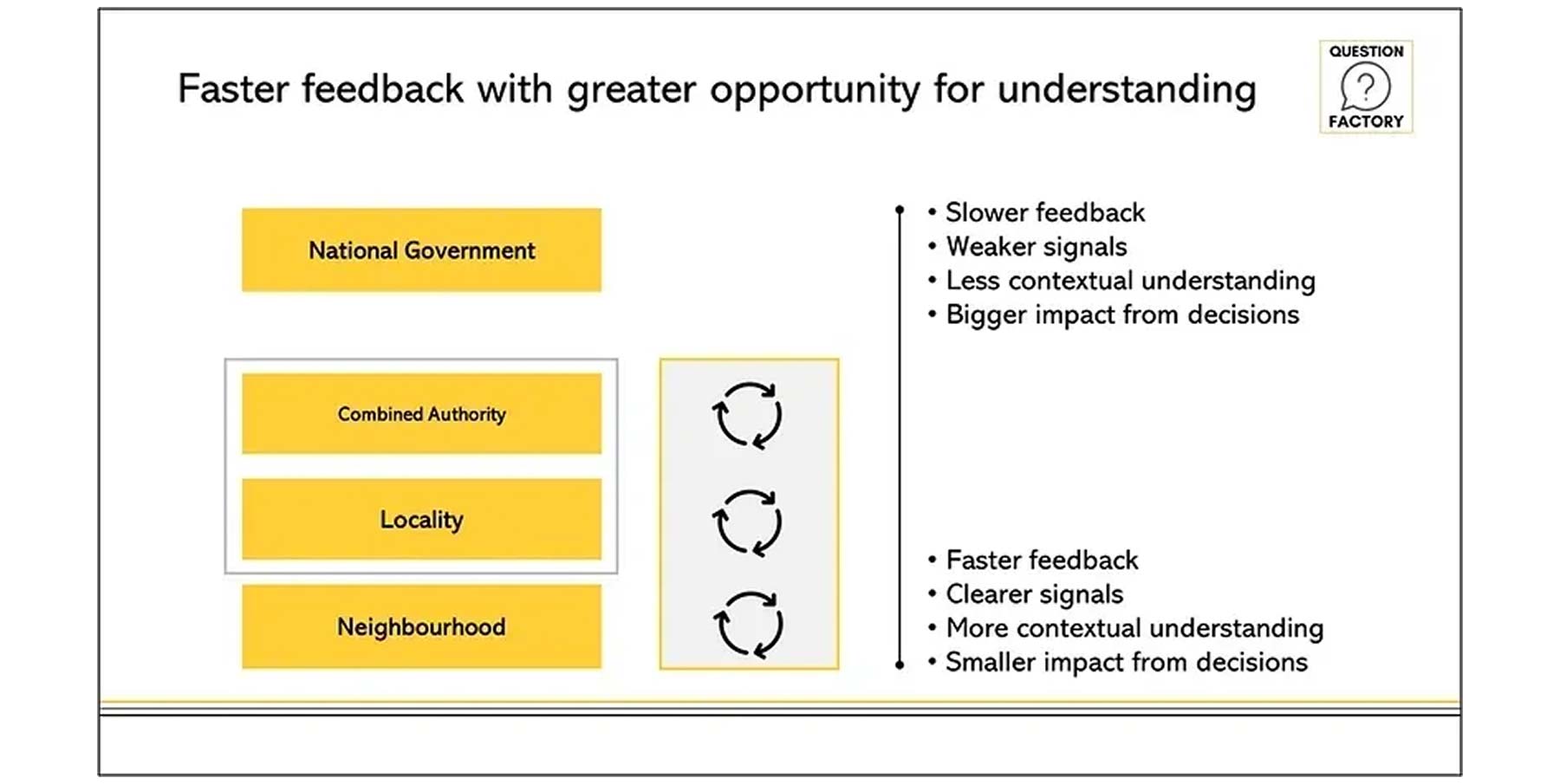
Devolving policy and funding decisions closer to places is a strong step away from a 20th century waterfall state towards a 21st century agile state; one that’s better able to experiment and respond to feedback (and I would add, rebuild trust).

Faster Feedback Cycle Graphic

So how we devolve, and particularly how we adapt the centre to accommodate devolved power, matters.
 

There’s a steep learning curve underway at the moment regionally and nationally. Both parties are trying different approaches to navigate how they engage with each other; working out when to push, when to cuddle; how to benefit from each-others’ strengths and how to avoid being an enabler of each-others’ vices.
 

But, despite the Mayors’ moment in the sun, there’s still a massive power imbalance in these relationships, and this creates the risk that we get stuck in chapter two.
 

In this story, CAs are just a more efficient way to produce transport plans for DfT, investment plans for DBT, housing plans for MHCLG, skills plans for DfE, energy system transition plans for DESNZ and nature recovery plans for DEFRA. This is a story of mini RDAs but with a bit more local legitimacy.
 

The story in which we avoid this, and instead fuse vertical ministerial accountability with horizontal mayoral accountability, and in which abstract policy models meet continuous feedback, still needs to be written; and before it can be written it needs to be built and it needs to be shown.
 

That’s the work we’re doing at Question Factory and if you’re doing it too we’d love to talk more about it.

Thinking Out Loud

We think you
might also like

View all

Contact

Want to know more?

Drop us an email today!

info@questionfactory.co.uk