I used a mission-shaped framing for a people-powered plan my team developed to help the Crown Dependency of Jersey become “the first carbon neutral jurisdiction in the British Isles”, though it turns out that translating participatory policy making into participatory delivery is a very tough ask.
I also led an un successful attempt to develop a mission-driven whole government programme. This struggled for several reasons, including the age old problem of getting to the right idea too late and without enough time to do it well.
Given this experience, I’m interested both in how Labour has framed it’s plans for mission-driven government, and how these will translate into practice. They’ve certainly got to the right idea at a sufficiently early stage (unlike me) and appear to be gearing up for the fight to graft cross-cutting missions onto vertical ministerial departments and agencies.
An obvious question for me to look at is how local government will view and engage with these missions. I think the aspirational framing will land well with both Labour and many other councillors, any with many public servants yearning for some narrative spice after years of thin gruel.
The main policy and public service interfaces are with the missions on economic growth, NHS improvement, justice reform and education standards. Many in the sector will be hoping, despite the gloomy messaging, that there might be some routes for investment into planning, social work, community safety, children’s services and education, to support delivery.
Beyond investment, I think there’s real scope for creative contributions to delivering the missions based on local leadership, more devolved strategic planning and a re-booted vision of public service reform (the latter of which absolutely has to (re)open the door to drawing NHS spending upstream and into place-based prevention).
I’m struck though, by the idea that central and local government will experience a mission driven government in very different ways.
Both benefit from strong public service values and motivations, but local government has a closer relationship with the communities they serve. At its best, we see this in a strong sense of civic pride, greater weight for feedback and lived experience in policy making, and shared hope for the future of their place.
Proximity can also act as rocket fuel for participation: the closer something happens to your house — whether it’s a planning application, a change to health or education provision, or the creation of a new community group — the more you are likely to be aware and perhaps even become involved in it. Place short-cuts complexity in today’s attention economy.
To make this point, I often draw on a passage from Simon Armitage’s excellent prose poetry collection, All Points North:
“Over the hill on the other side is Saddleworth, Lancashire. Saddleworth used to be in Yorkshire, but the Boundary Commission recognized the watershed for what it was. One day a sign appeared at the brow of the hill saying Oldham Metropolitan Borough in bright green letters. The day after that, the sign was obliterated with a shotgun wound, a hand-painted board with the word Saddleworth was planted in front of it, finished off with a huge white rose…”
For me, this story makes the point about the latent motivating power of place.
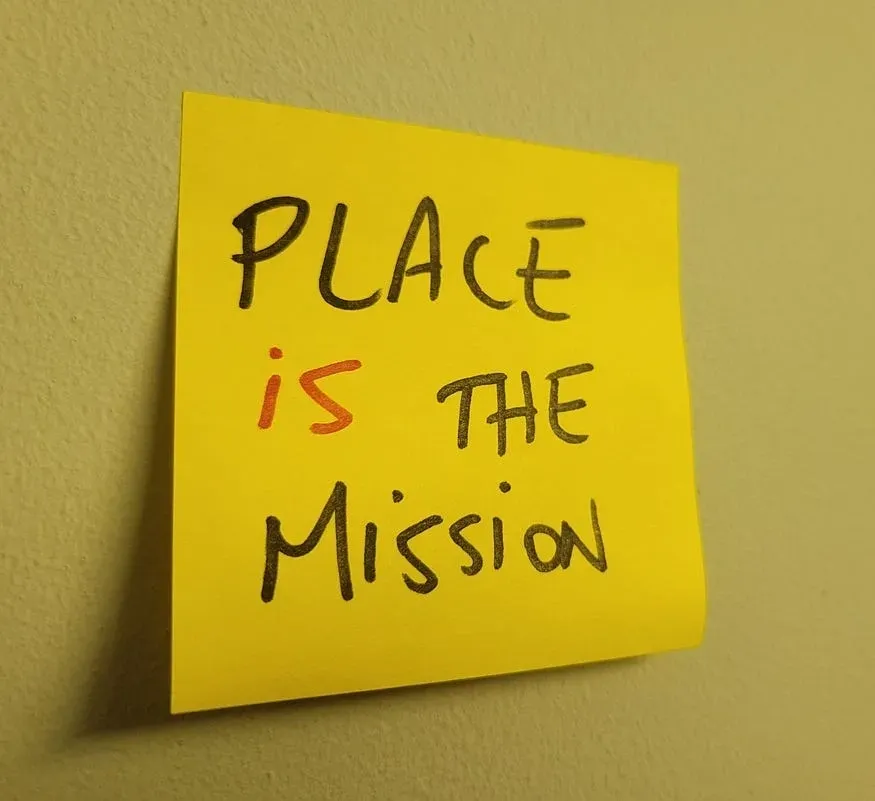
My short-hand summary for all this is that, for many of us that remain devoted to local government, place is the mission. It already is.