Working with the Radical How
This case study surfaces again in the recent Radical How report from Public Digital and Nesta, which describes “a new approach…to shift government from an organisation of programmes, projects and paperwork, to one of missions, services and people.”
I’ve been working with a very similar framing for several years now — trying, learning, failing, trying again.
Some of this work has been in areas, like the development of a community grants service, that lend themselves to a #policydesign or Radical How approach (community grants require similar capabilities to the Universal Credit and Future of Farming case studies in the report).
A lot of my attempts to design in and deliver agility have also been in contested political spaces, like major infrastructure planning or cross-government spending reviews, where internal tension and carefully stage managed policy releases, rather than collaboration and iteration, are the default. I’m slowly distilling the practice insights from this work, for another day.
For now, among all the good stuff in the Radical How principles, the issues of accountability and devolution jumped out to me, and to others.
An analogue concept and systems of accountability are, I think, very much the root of the waterfall mindset that demands false certainty. Shifting this bit of deep state system design is probably the single biggest intervention point to increase agility (‘system acupuncture’, to borrow a phrase).
But devolution is the issue we’re working actively with at Question Factory currently so let’s stick to that.
Missions, devolution and agility
To start, we can blend national missions with place-based missions; I don’t think the approach is inherently centralist. Clear national strategy focused on outcomes, together with devolved delivery, to me seems to fit the model. A national test and trace mission could have been delivered through devolved structures without needing to adopt a waterfall approach.
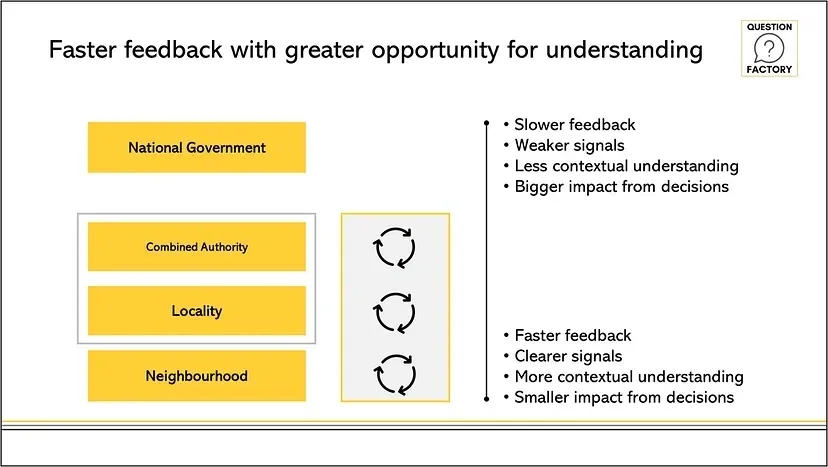
In fact, I think there are at least two good reasons that greater devolution enables more agile and iterative delivery. A couple of caveats first though:
· My thinking and language are very much a product of the Greater Manchester Combined Authority because that’s the one I know the best and where we’re working these ideas through at the moment. I know other combined authorities are different but given the peer recognition of GMCA as ‘the undisputed pioneers of English devolution’, I figure learning from this system is likely to have wider relevance over time.
· By ‘greater’ devolution I mean to more places, across more areas of policy, and of more substantive powers and accountabilities. Basically, substantially re-constituting the place-based strategic capability of UK governance. We’re much more interested in capability (including culture) than in structure (with an interest in governance sitting somewhere between the two).
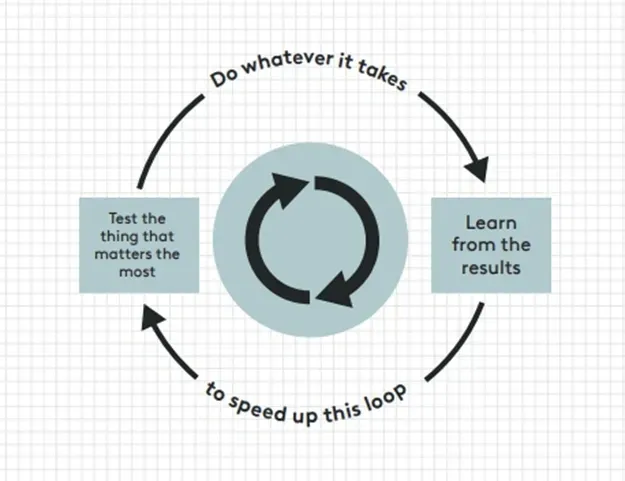
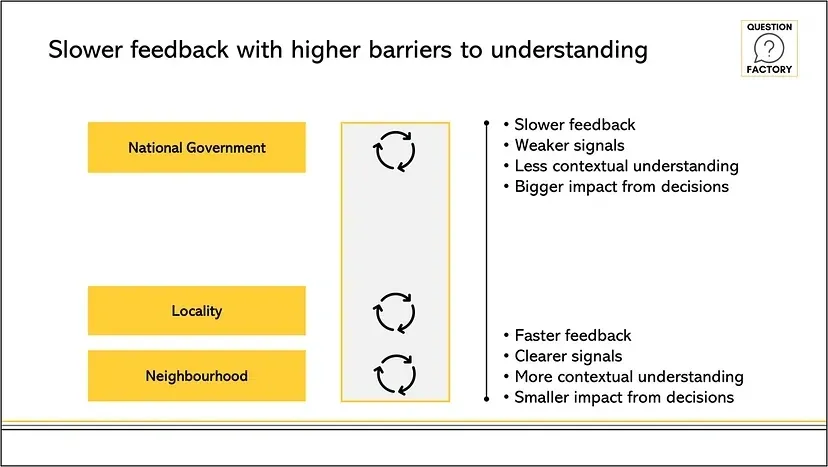
In simple terms, the value of devolution in delivering the Radical How all comes down to feedback — how do we hear it, how do we interpret it and how do we act on it? As the authors put it, do whatever it takes to speed up the test and learn loop.